
Unveiling Aphrodite
The integral need for art, beauty, love, alchemy and sensuality

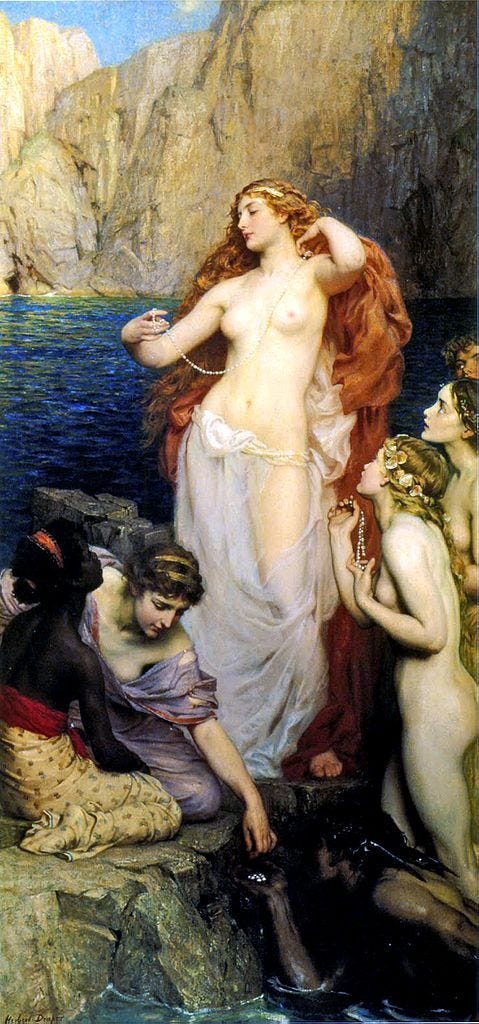
‘The Pearls of Aphrodite’ by Herbert James Draper, 1907
Post the industrial revolution, we have seen a decrease in time well spent engaging in the arts, in love, the process of alchemy, the pleasures of the body; for knowing oneself and others (as opposed to a detached, hedonistic modern interpretation of “pleasure”). We are disengaged from our senses; we frequently narcotise with television, food, pornography, video games, work, alcohol and other addictions. We dissociate and numb ourselves from the world we have found ourselves adapting to against our wills.
Most of us are half asleep. We have to be. If we were to remain in the present moment, to be as conscious and mindful as we could, we would not be able to bear the burdens of our time. And so we retreat into our shells. It is at times like these where I find the artwork depicting the birth and arrival of Aphrodite, often bursting forth proudly from a seashell upon sea-foam surrounded by angels, cherubs and admirers as an antidote to our times.
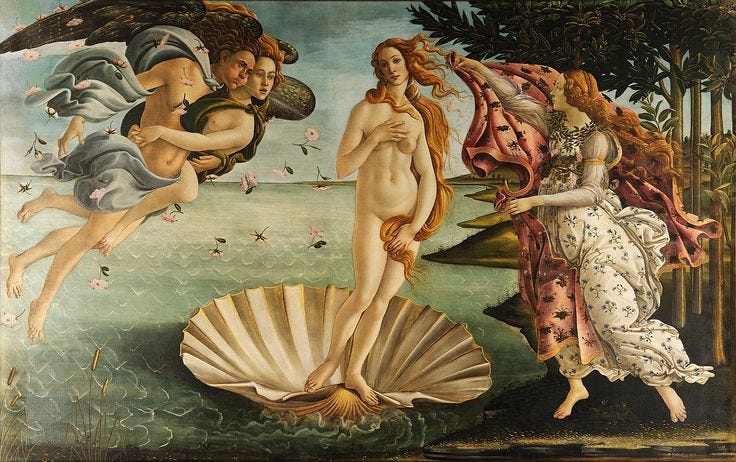
‘The Birth of Venus’ by Botticelli, 1485–1486
In this series of goddess archetypes I find our current multicultural, globalised world lacking specific archetypes. The Industrial Revolution being a key recurring theme of when these archetypes were truly snuffed out and relegated to the shadows.
Aphrodite in our collective unconscious: jailed away from the light of day, no sun to shine on her and reveal her beauty, no moonlight to softly veil her nude form, just a cell we have confined her to and carelessly lost the key. Such a powerful Goddess archetype as Aphrodite in shadow form wreaks havoc on us all. It plays out most obviously in our many addictions and abhorrent behaviours to get any sense of relief and pleasure in this world. But on subtler notes; we have lost the mind’s eye, we have lost a visionary and imaginative flare, few truly appreciate art and beauty beyond a post on instagram to show you are “cultured”. And we have lost the mind-body-soul connection esoterics spoke of in days gone by. We have lost, I would argue most direly, our ability to alchemise what is broken into that which is beautiful and enduring.
Aphrodite as an archetype represents a blend of what Bolen called the Virgin Goddesses (Hestia, Athena, Artemis) and the Vulnerable Goddesses (Hera, Demeter, Persephone); she is both virgin (whole unto oneself, unharmed by men) while also in relationships with men (penetrated and vulnerable). However unlike the vulnerable goddesses who are usually beholden to one lover and often have been harmed by men, and unlike the virgin goddesses who are rigid and hard to merge with or know, Aphrodite defies these conditions. She is both whore and the saintly; she has many lovers and is also loyal to Ares; men have not violated her body, but instead built shrines and statues; she has inspired poetry, theatre, music and art of the highest caliber; and she herself is the embodiment of love, beauty, creation and alchemy.
So how does one go about finding the key to the prison she is confined in, how does one lift the veil and bear witness to the glory that is the archetype of Aphrodite? How do we as a collective integrate her into our individual consciousnesses and collective unconscious in an intentional, embodied way?
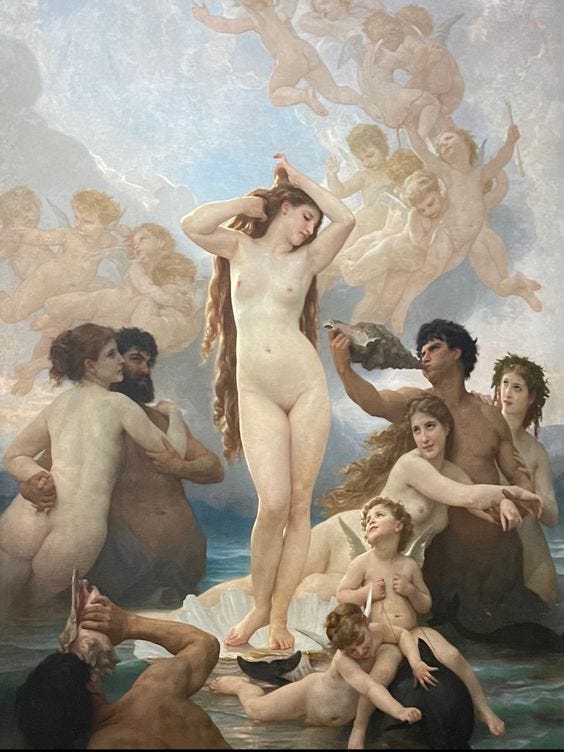
‘The Birth of Venus’ by William-Adolphe Bouguereau, 1879
One thing that, while it has become a bit of a fad in pop psychology, was a meaningful way of life for many ancient traditions, is mindfulness. In the case of integrating Aphrodite consciousness it is important to connect back to our body (something modern life does its very best to disconnect us from). One of the simplest and most effective ways is to engage the five senses, and to do so with mindful intention.
Upon waking, stay in silence to listen to what you can (or cannot) hear before starting the day. Take pause to feel what is interacting outside of and inside of your body, what aches and pains, pleasures and such, can be felt? Is the fabric pleasant or irritating on your skin? What does the temperature feel like? You can include scent too; the smell of perfume, flowers, cooking or even unpleasant odours are still useful to ground you in the present. Sitting down after mindfully preparing a meal and really engaging your tastebuds, how does the food feel in your mouth? Can you notice individual ingredients and how they combine? What makes this dish so tasty? What could be improved? What brings you pleasure? And finally sight, noticing the natural and man-made beauties in our world, along with making conscious effort to not only beautify oneself but the spaces one occupies. Beauty has psychologically been proven to soothe an anxious, preoccupied mind.
There is a work ‘The Sacred Prostitute’ by Nancy Qualls-Corbett (a jungian analyst) which touches on themes I want to discuss here, as well as the actual act of “foreplay” or simply what I would consider “play”.
In ‘The Sacred Prostitute’ it touches on the ritual of preparation for the “act”. A woman spending a whole day bathing, anointing her body with oils and perfumes, dancing, beautifying herself and the space around her, to in turn have an evening of allowing the “Other” into this sacred space and into her. Often long after the “sacred union” she describes a feeling of lasting ecstasy.
Onto a more personal advocacy for what people deem “foreplay,” but I consider an unending play, and the act of orgasm should not necessarily be the end of play. Engaging in sexual acts with the goal of orgasm seems reductive to me. The joys of the body, of connecting with another physically, mentally and spiritually are some of the most sacred, Venusian experiences we can have. There should be no rush to “finish” no matter how pleasurable climax is. Also climaxing for women in heterosexual relationships has often proven to be neglected once a man ejaculates, whereas a true lover would be prepared if he “finished early” to continue playing with her for hours if need be, but also without the pressure to climax. Sex, lovemaking, union, “fucking” whatever you wish to call it, should be an act of play and of connection and of being in the body, of experiencing the sensuous pleasures that are, in a sense, holy.
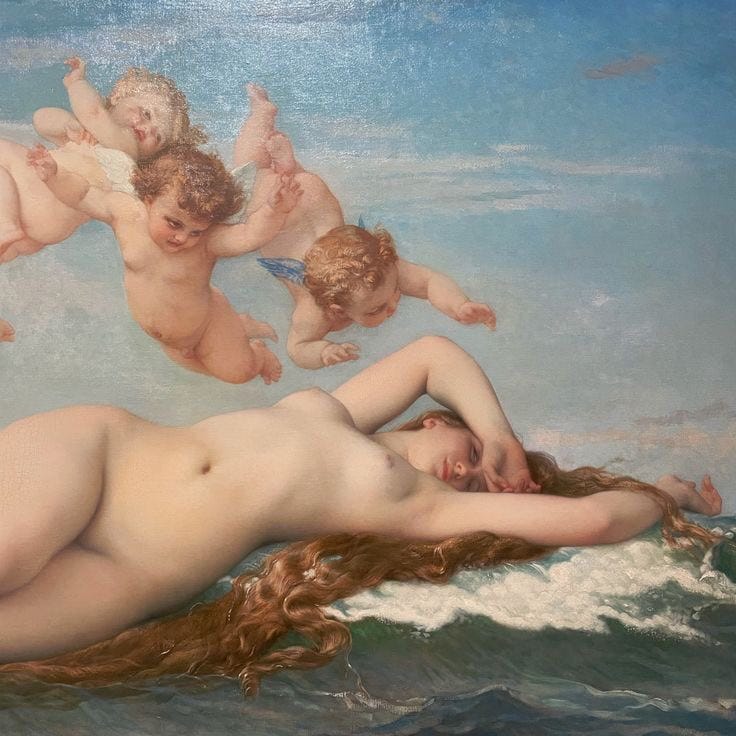
‘The Birth of Venus’ by Alexandre Cabanel, 1863
There is an attitude towards beauty that it is superficial. And of-course there are superficial, vain attempts at beauty, but I would highlight the word “attempts”. That which is truly beautiful, that is, that which moves us, is never superficial.
There is a demonisation of beautiful things; whether that is gardening, putting an hour aside to beautify oneself in the morning, interior design, or photography/visual art that is considered “unnecessary” or “lesser” simply because its main focus is aesthetic value, to imbue a sense of beauty in the observer.
There is also a simultaneous pornification of the female form as well as a condemnation of women who spend too much time and money on “beautifying” themselves. Both are reactionary and missing the meaningful, moving quality of beauty.
Beauty is an expression of love; to intentionally cultivate beauty in yourself and your environment is an act of love, and an expression of the Aphrodite archetype.
“Truly fertile Music, the only kind that will move us, that we shall truly appreciate, will be a Music conducive to Dream, which banishes all reason and analysis. One must not wish first to understand and then to feel. Art does not tolerate Reason.”
— Albert Camus
Art is not always Venusian, but art is a doorway into expressions of the archetype of Venus/Aphrodite. To be a muse is to be a portal to Aphrodite consciousness. To create works of art and be possessed by this creative daemon, is to have the golden light of inspiration, of Aphrodite, rise up from the collective unconscious and flood your psyche.
’Art as Therapy’ by Alain de Botton and John Armstrong is an excellent book exploring the ways art is therapeutic (empirically so), and I strongly suggest reading it. It contains within the pages some of history’s most marvelled works of art and also art that went over-looked or unnoticed.
Attending a local artists launch, travelling to great cathedrals, museums, galleries, is a great way to open yourself up to this expression of beauty, and the undeniable depth and profound effects it can have on our psyche (mind-soul).
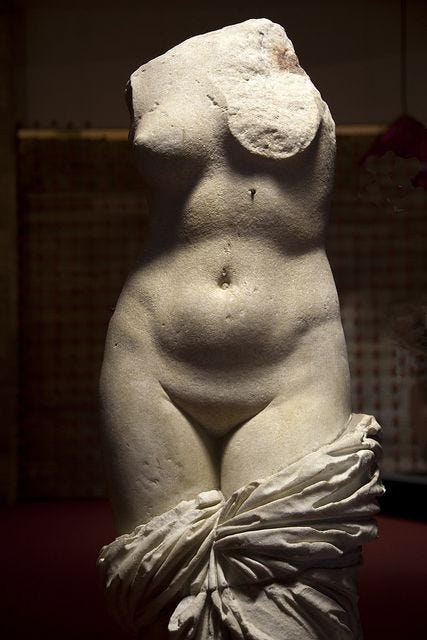
2500 year old statue depicting Aphrodite/Venus, Paestum Archaeological Museum, Campania, Italy
I was sitting on the bank of the harbour, watching the waves lap over the rocks; they danced around them, swirled, gushed over and retreated. In that moment I thought of how nature enjoys playing with herself (akin to masturbation). Abstracted further, I thought of how this is literally true, all of life on earth is born out of Mother Nature playing with herself and co-creating within herself. All life on earth is born out of the womb of Mother Nature: the ocean.
Aphrodite was born out of the ocean, and the ocean in Jungian psychology is a representation of the unconscious depths.
There is an epithet of Aphrodite, “Aphrodite Ourania” which not only meant heavenly, but also the conception of, “she is that which keeps together the entire cosmos and continues the survival of all.”
The primordial archetype that is expressed through the goddess Aphrodite is the Divine Lover; it is from her love, her ability to create from herself, and that her creations can merge together to alchemise new creation ad infinitum, that all life on earth continues to sustain itself.
This enduring power of love, alchemy, creation, sensuality and beauty is within all of us. It is up to us to lift the veil, find the forgotten key and unlock the prison Aphrodite has been confined to for hundreds of years.
It is our duty as Lovers, as sentient beings, to unveil the archetype of Aphrodite and integrate her into our personal unconscious, so that we may raise Venusian consciousness and co-create once more with Mother Nature—Aphrodite Ourania.